Editorial: Waode Yunia Silviariza
| SDGs (yang dibidik program kegiatan) | Sustainable Development Goal (SDG) 8: Decent Work and Economic Growth |
| Started (Tgl Mulai) | Monday, July 28, 2025 |
| Ended (Tgl Selesai) | Monday, July 28, 2025 |
| Number of participants (Jumlah anggota tim pelaksana kegiatan) | 30 |
| Program Studi yang terlibat (Sesuai anggota tim pelaksana) | S2 Pendidikan Geografi |
| Service Hours (Durasi Program) | 6 Jam (08.00 am - 15.00 pm) |
| Beneficaries (Penerima manfaat langsung) | S1 Pendidikan Geografi dan S2 Pendidikan Geografi |
| Location (Tempat kegiatan) | Gedung Pascasarjana FIS UM |
| Collaborator | Dr. Saiful Amin, M.Pd., a lecturer at UIN Maulana Malik Ibrahim Malang |
| Impact Scale (Skala Dampak) | Departemen Geography |
| Link/ Tautan Foto/ Video Kegiatan (g-drive open access) | https://drive.google.com/drive/folders/1jyUk6G32oGG2Hf4OwS7lb-CybOVujHhH?usp=drive_link |
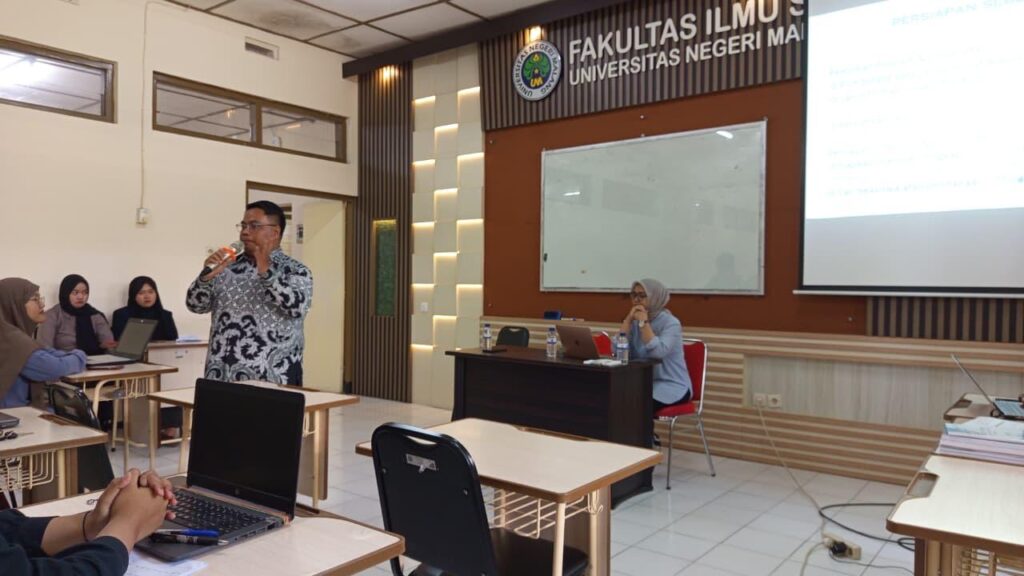
The Department of Geography at Universitas Negeri Malang (UM) once again demonstrated its leadership in nurturing high-quality and professionally resilient graduates by organizing a Guest Lecture and Workshop titled “Preparing Visionary Geography Graduates: Postgraduate Studies and Quality Scientific Works” on Monday, July 28, 2025. The event was held at the Graduate Building of the Faculty of Social Sciences and was attended by final-year undergraduate and master’s students in Geography, who are currently at a critical phase of entering their next academic or professional stage.
Dr. Saiful Amin, M.Pd., a lecturer at UIN Maulana Malik Ibrahim Malang and an alumnus of UM’s Geography Education Program, was invited as the keynote speaker. He presented practical and inspiring strategies on how students can plan their graduate (S2/S3) studies effectively while also developing a strong portfolio of scientific works early on. In the following workshop session, students were guided in drafting the initial version of their scientific article, with the potential for future publication or as part of their final academic project.
This initiative reflects the Department’s real contribution to Sustainable Development Goal (SDG) 8: Decent Work and Economic Growth. The strengthening of academic capacity among students is seen as an entry point for producing graduates who are well-prepared to access dignified, productive, and competitive job opportunities. The department strongly believes that graduates equipped with scientific literacy, writing experience, and a postgraduate study orientation possess a distinct advantage in an increasingly knowledge-driven labor market.
More than that, this activity was designed to address the persistent gap between academic training and real-world employment demands. The practical and intensive workshop shifted the role of students from job seekers to career designers—individuals who are aware of the need for innovation, global competitiveness, and continuous personal development.
This is the strategic climax of the activity’s contribution to SDG 8: higher education must serve as a factory of ideas and human capacity that responds to the economic challenges of today and tomorrow. Students are not simply being trained to graduate, but to emerge as young professionals who are reflective, impactful, and capable of driving transformation through both academic and non-academic paths.
The Department of Geography affirmed that this activity was far from ceremonial; it is part of a systemic commitment to build strong connectivity between academic spaces and the professional world. This initiative will continue to be part of the department’s strategic efforts to produce graduates who are not only competitive, but also innovative, purpose-driven, and responsive to real-world change.
